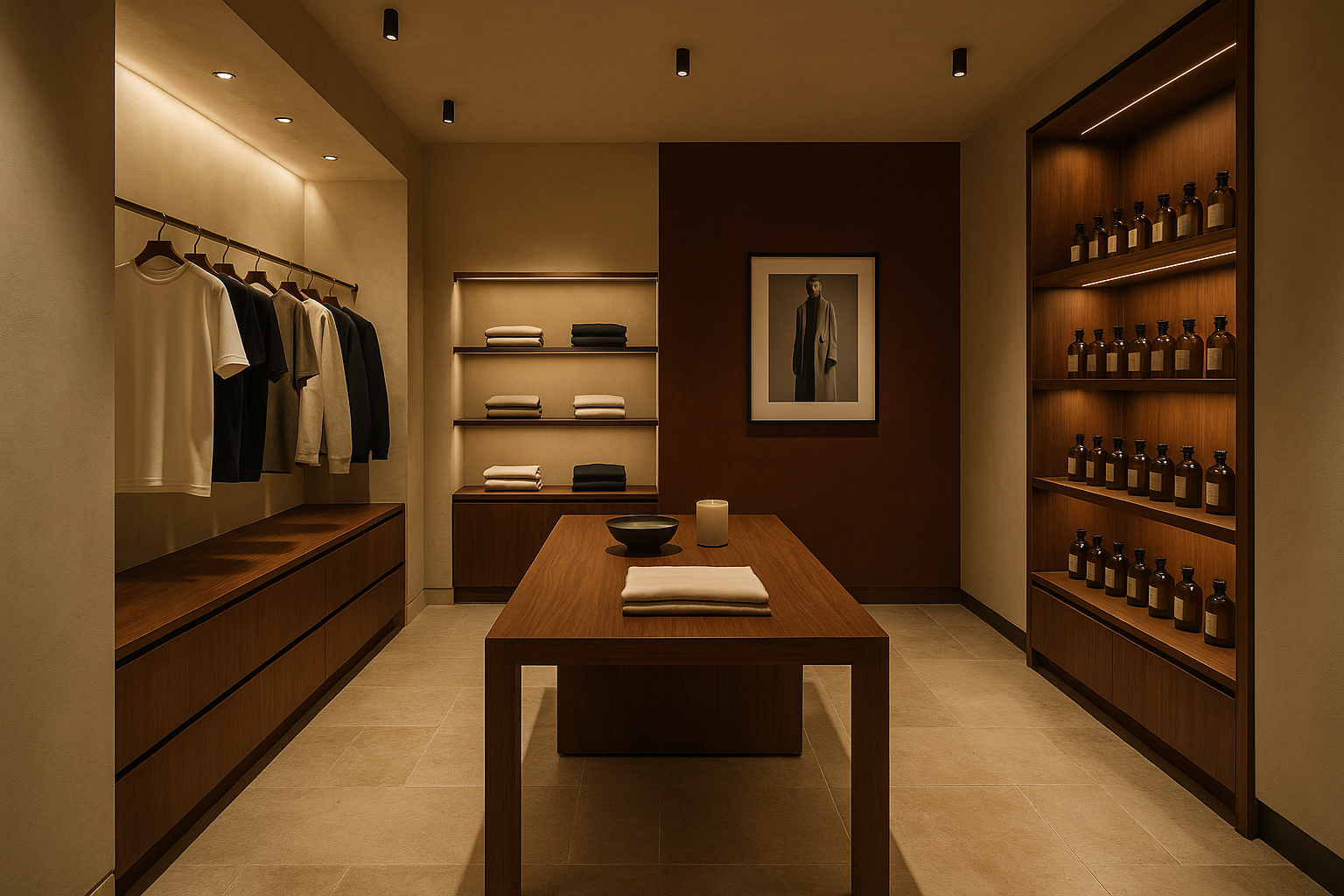
VAULT Micro-Boutique
Footprint: 800 square feet, adjacent to the café and the members lounge, direct sight line from the front desk. Owner: Merchandising Lead Reports to: Taj (aesthetic), CSO (numbers) GM interface: shrink audits, staffing overlap with front desk
1. Role of the Boutique
The boutique is not a store. It is the physical proof that VAULT is a brand, not a gym.
Three jobs:
- Convert. Every member walks past it four times per week. Impulse plus proximity plus tier discount is the entire conversion mechanic.
- Merchandise the ecommerce channel. Members touch fabric in club, then reorder online at 2 a.m. In-club is the funnel top for DTC.
- Editorialize. The boutique doubles as a photo set. Every drop shoots partially in-club. The visual merchandising is the campaign.
Weekly foot traffic model Y1: 800 members averaging 2.4 visits per week is 1,920 boutique passes. Conversion target: 6 percent of passes into a transaction, average ticket 148. That is 17,000 per week or 880,000 annualized just from foot traffic, before walk-ins and guest passes.
2. Assortment Strategy
800 square feet forces discipline. Assortment is edited weekly, not seasonally.
At any given moment on floor:
- 60 percent Track A studio performance (the reason members shop here first)
- 25 percent Track B athleisure crossover
- 10 percent accessories (grip aids, water bottles, hair silks, robes, socks, towels)
- 5 percent VAULT Invitational competition merch (rotates during competition season only)
SKU count on floor: 45 to 55 active SKUs at any moment. Overstock lives in a 120 sq ft back-of-house room.
Depth model: - Never more than 8 units per SKU on floor - Backstock holds 3 to 4 weeks of sell-through - Weekly replen from a 3PL (see ecommerce doc, same 3PL serves DTC)
Members-only pieces (Founding Member Jacket, Black Card Robe) are not on floor. They are issued from the front desk on membership activation. This ritualizes tier.
3. Visual Merchandising Standard
Reference points: The Row Amagansett, Aime Leon Dore Mulberry, Aesop Rittenhouse, Alo Yoga Beverly Hills at its best, not its most recent.
Fixtures: - Blackened white oak millwork, custom built by a Charlotte or Asheville shop (Sanders Millwork, HR Woodworking) - Brushed brass hardware - Travertine plinth as the center table for weekly featured drop - Two full-height mirrors, side lit only, no overhead retail lighting - No slat walls, no gridwalls, no acrylic fixtures, no logo mannequins - Two dressing rooms, curtained not doored, curtains in the same waffle knit as The Robe
Lighting: 2700K throughout. Track lighting on the plinth. No fluorescents anywhere. If the front desk lighting is 3500K, the boutique is still 2700K. This is a boundary.
Music: separate zone from the studio floors. Slower, quieter, curated by Taj monthly.
Fragrance: subtle. Diptyque Baies or a custom VAULT scent commissioned Y2 (see brand doc). Not a Bath and Body Works store.
Weekly reset: every Monday morning before opening, the merchandising lead and one associate reset the floor. Featured piece moves to the plinth, sell-through data drives what leaves floor, what comes forward. This is non-negotiable.
4. Inventory Model
System: Shopify POS in-club, tied to the same Shopify backend as DTC (see ecommerce doc). One inventory pool, two channels.
Receiving: all inventory ships to the 3PL, boutique pulls weekly replen from 3PL not from mill direct. This centralizes shrink tracking and lets DTC and boutique compete for units cleanly.
Shrink target: less than 1.2 percent. Charlotte luxury retail averages 1.8 percent. Below 1.2 requires: - POS-tied door count sensor - Backroom locked, one keyholder per shift - Weekly cycle counts on top 20 SKUs - Monthly full physical count with the GM’s ops assistant
Markdown discipline: nothing on floor is marked down. Ever. Old-season inventory routes to the annual archive sale (see apparel doc), which runs 48 hours online only. In-club never sees a sale rack. Sale racks kill the ticket average and cheapen the fabric story.
Sizing: XXS through 3X on Track A and B core pieces. No exceptions. The pole and dance community is a body-diverse community and the assortment must reflect that or the brand fails on Day 1. Extended sizes carry the same margin as core, not less.
5. Staffing
Boutique headcount Y1:
- 1 Merchandising Lead (full time, salary 78,000 plus 2 percent of retail net, reports to Taj and CSO)
- 2 Boutique Associates (part time, 30 hours each, 22 per hour plus commission at 4 percent of personal sales)
- 1 Weekend Lead (25 hours, 26 per hour plus commission)
Total Y1 boutique payroll: roughly 175,000 fully loaded.
Hiring profile: the associates come from the pole and dance community. They are members first, associates second. A member selling to a member converts three times better than a hired retail associate. This is Bandier’s Nolita playbook and it works.
Training: two-week onboarding covering fabric story, mill provenance, tier pricing logic, POS, and Taj’s aesthetic filter. Every associate must be able to answer the question “why does this cost 168 dollars” in one sentence.
Uniform: associates wear current-drop VAULT, comped monthly at cost. Two full outfits per month per associate. This is a marketing line, not a payroll line.
6. Café and Boutique Integration
The café sits adjacent to the boutique with no wall between them. A member can order an oat matcha, browse the plinth, try on the Column Pant, and check out at one register.
This adjacency drives 22 to 28 percent lift on both average boutique ticket and café ticket, based on Bandier’s Studio B integration data and Equinox’s Selfridges pilot data. Do not silo them.
Café staff and boutique staff cross train on POS but not on merchandising. A barista does not fold. An associate does not pull espresso.
7. Guest and Non-Member Access
Non-members can shop the boutique. They enter through the front desk lobby, get a boutique-only pass, are not permitted into the studios or locker rooms. This drives 12 to 18 percent of boutique revenue in Y2 and Y3 and is the softest possible top-of-funnel for membership itself.
Non-members pay full retail. No boutique-only discount ever. The discount is the membership.
8. KPIs
- Boutique revenue per square foot: target 1,200 by end of Y1, 1,600 by end of Y2. Alo Yoga’s best doors do 1,800. Reasonable ambition.
- Attach rate: 1.6 items per transaction Y1, 1.9 by Y2.
- Member vs non-member mix: 78 percent member Y1, 65 percent Y2 as non-member access matures.
- Shrink: under 1.2 percent.
- Sell-through by drop day 45: 65 percent.
- Return rate: under 6 percent (industry average for luxury athletic is 11 percent, in-club fitting rooms kill returns).
Weekly report to Taj and CSO every Monday by 10 a.m., three metrics: revenue, top three SKUs, one merchandising note.