THE VAULT INVITATIONAL · Broadcast Production Spec
The Walker Group technical brief. Not decorative. Concert-scale, timecode-locked, broadcast-grade. Every line item is a real vendor at a real spec because that’s how a category-defining property gets built.
Extends 00_COMPETITION_BRIEF. Read that first.
Design principle
VAULT INVITATIONAL is not a sport broadcast with pretty lights. It is a Trill Walker music-production show where the athletes are the artists. Lighting cues fire to music timecode. Cameras cut to musical phrase, not to referee whistle. Audio is mixed for broadcast simultaneously with PA, and the two feeds never drift because MTC + LTC are locked to a single house clock.
This is the Beyoncé/Doechii/GloRilla playbook applied to a movement championship. That is why TWG holds the exclusive production contract.
Y1 Charlotte · in-house main studio broadcast mode
Y1 runs inside the VAULT main studio configured as a broadcast set. 150 to 200 seat capacity. This is intentional. Y1 is IP + format lockdown, not audience scale. The room becomes a controlled environment where every technical decision can be defended, tested, and documented for Y2+ scale-up.
Room prep begins Wednesday (T minus 3), tech day Thursday, dress Friday morning, gala Friday night, prelims Saturday, championship Sunday. Strike Monday.
Lighting package
Console. MA Lighting grandMA3 full-size + grandMA3 light backup on tracking network. Programmer + operator + spot caller as three separate seats during show, single-op during rehearsals.
Moving heads. Twenty Chauvet Professional Maverick Force 3 Profile (500W LED profile, CMY, framing shutters) on downstage + midstage overhead truss for key + gobo texture. Twelve Elation Proteus Maximus (IP65 hybrid) on upstage + wing positions for beam looks, aerial breakups, and the halftime performance package that needs the full moving-head vocabulary a music show demands.
Wash + eye candy. Twenty-four Chauvet Rogue R2X Wash for stage wash + audience blinder cross-lighting. Eight GLP impression X4 Bar 20 as pixel-mapped batten strips upstage for lookbook moments and sponsor-brand color washes (Hennessy amber, Hot 97 red).
Conventional + specials. Judge-panel key light on ETC Source Four LED Series 3 Lustr X8. Athlete entrance tunnel gets Astera Titan Tubes battery-powered on wireless CRMX for handheld + pole-mounted work by camera-facing dancers.
Atmosphere. Two MDG ATMe hazers on DMX with airflow tuned for broadcast (haze visible on camera without fogging the audience seating). Low-fog Look Solutions Viper for the reveal cues only.
Data + power. Full MA-Net 3 backbone, redundant. All fixtures on Luminex GigaCore switches. Power distribution via Motion Labs Racelink 400A three-phase mains + LEX distro for house.
Timecode. grandMA3 chases MIDI Timecode (MTC) generated by the audio playback rig (Ableton Live master). LTC (Linear Timecode) sub-generated for cameras + video switcher. One clock. One truth.
Video + broadcast package
Cameras. Eight-camera rig for Sunday championship (six for prelims, four for gala).
| Position | Camera | Purpose |
|---|---|---|
| Cam 1 (hard center) | Sony HDC-3500 4K UHD studio | Master wide + host coverage |
| Cam 2 (hard house-left) | Sony HDC-3500 | Judge panel + reaction |
| Cam 3 (jib) | Sony HDC-3500 on Jimmy Jib Triangle 24 | Sweeping stage moves, halftime performance |
| Cam 4 (Steadicam) | Sony HDC-P50 on ARRI Trinity | On-stage athlete follow, transitions |
| Cam 5 (polecam) | Blackmagic URSA Broadcast G2 on 12ft carbon polecam | Overhead + apparatus-adjacent |
| Cam 6 (handheld broadcast) | Sony HDC-P50 handheld | Backstage, athlete waiting, judge tables |
| Cam 7 (crash cam low) | Blackmagic URSA Broadcast G2 low-angle | Floor work, pole base, feet |
| Cam 8 (locked ISO wide) | Sony HDC-3500 | Full-stage safety wide + archival |
Fiber back to control via Sony HDCU-3500 CCU units. Full Grass Valley LDX camera control philosophy where a shader rides all cameras in real time.
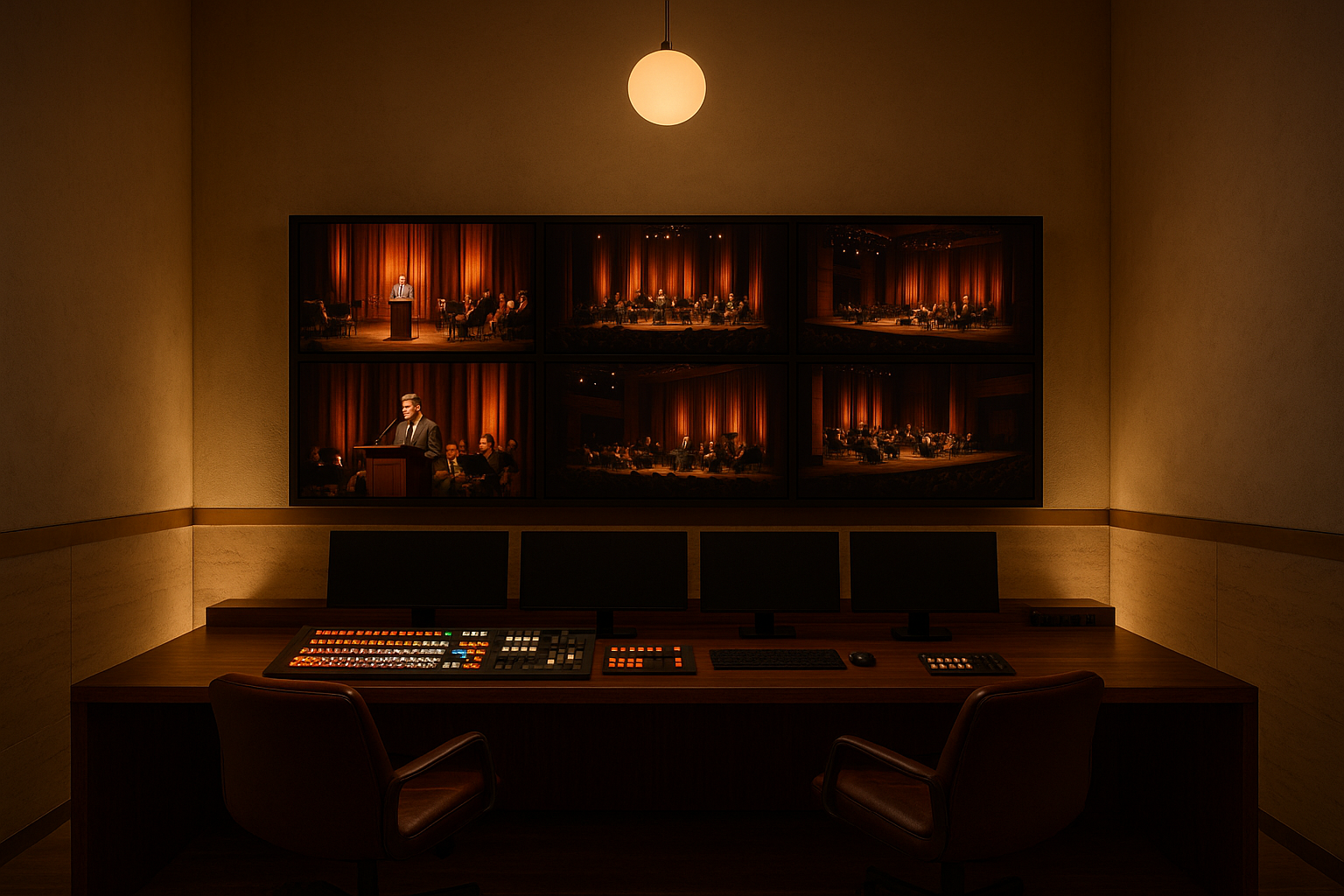
Video switcher. Ross Carbonite Ultra 2M/E as primary. Blackmagic ATEM Constellation 8K as backup + secondary program for the streaming and social ISO feeds. Two separate PGM outputs: the “show” line-cut and the “social” cut (looser, more B-roll, cut for vertical clip export).
Replay. EVS XT-VIA four-channel for judge replay + broadcast highlight. Judges see replay on panel monitors between rotations. Post-production edit team pulls EVS clips into an Avid Media Composer + Adobe Premiere hybrid workflow the same night for morning-after highlight drops.
Graphics. ChyronHego PRIME for lower thirds, athlete scores, sponsor bugs. Scores hot from the judging tablets (custom app, see 04) directly into PRIME data feeds so numbers on screen are the numbers judges tapped 400ms earlier.
LED + projection. Upstage LED wall ROE Visual Black Pearl BP2V2 (2.84mm pitch) 40ft wide by 12ft tall for athlete intros, sponsor content, and mid-round music-production visuals. Content run from disguise gx 2c media server, timecoded to the show clock so upstage LED cuts to a Latto vocal downbeat frame-accurate.
Streaming rack
Y1 stream is free on YouTube Live under VAULT-branded channel. Free is not the same as low-spec.
Encoder path. Primary: Mux Pro live streaming service, 1080p60 at 8 Mbps H.264. Dual encoder redundancy via Vimeo Livestream as hot backup, auto-failover if Mux drops below quality threshold. Both encoders fed from the same PGM SDI out of the Ross Carbonite through a Blackmagic Teranex Mini H.264 Pro Recorder + Mux Video ingest.
Redundancy. Two internet paths. Primary fiber (Charlotte metro business fiber, 1 Gbps up). Backup bonded cellular via LiveU LU800 (five modems, four carriers). If fiber dies, LiveU takes over inside two seconds.
Multi-language + accessibility. Primary broadcast English. Y1 optional Spanish commentary track fed as SAP-equivalent audio channel. Live captioning via 3Play Media human-captioned live feed for compliance and social clip accessibility.
Y2+ evolution. Y2 NYC broadcast partner (Prime Video, YouTube Premium, or Peacock negotiation) triggers upgrade to full triple-encoder redundancy + separate broadcast rights master feed handed to partner via Zixi or SRT protocol from a dedicated master control position.
Audio production
FOH + broadcast are separate mixes off the same house console.
Console. DiGiCo SD10 at FOH with an SD-Rack + orange DMI-MADI card feeding a dedicated broadcast mix engineer position running a Yamaha CL5 as broadcast mixer. FOH mixes for the room. Broadcast mixes for stream + PGM record. Two engineers, one show.
PA. L-Acoustics Kara II line array, twelve per side, K2 subs flown, LA12X amplifiers. This is a music-production PA in a broadcast-scale room, chosen because L-Acoustics is what Beyoncé’s Renaissance and Cowboy Carter tours run and it is the PA that makes a broadcast mix sound like a concert. Y1 Charlotte room is small enough that Meyer Sound LEOPARD would also work, but Kara II is the answer that scales cleanly to Y2 NYC and beyond, so it is what we spec now.
Monitors. In-ear only for MCs, live band, and DJ. Sennheiser 2000-series IEM. Two Clair 12AM stage wedges for the halftime performance artist only if requested.
Wireless. Shure Axient Digital across the board. Six AD4Q receivers, twelve AD2/SM58 handhelds for MCs + interview positions, ten AD1 bodypacks with DPA 4088 headworn for choreographers on stage + judges on panel. Full RF coordination handled by TWG RF tech (Dusty at Glen Canyon Audio, if IDE Lab spec applies). Backup channels + spare mics tested every rehearsal block.
Playback. Ableton Live 12 on Mac Studio M2 Ultra, dual-machine primary + backup with MOTU AVB switch for seamless failover. Ableton generates MTC that clocks lighting + video. This is Trill’s playbook, replicated exactly.
Live band. Y1 Sunday championship uses a 6-piece live band (MD/keys, drums, bass, guitar, second keys, aux perc/DJ) for the halftime performance + between-round musical stings. Live band tracks + click print from the same Ableton rig. Live band FOH channel count budgeted at 24 inputs.
DJ position. Pioneer DJ CDJ-3000 pair + DJM-A9. Independent stereo pair into DiGiCo. DJ has ability to trigger tempo-locked broadcast bumpers between competition rotations.
Timecode-locked lighting to music · Trill’s playbook
The single differentiating technical decision. It is why VAULT INVITATIONAL is a music show that happens to be a competition, not a sport telecast that happens to have music.
How it works. Every athlete’s competition run is programmed as an Ableton session. Their chosen music track (or custom edit) lives on that session. Lighting cues in grandMA3 chase MTC generated by Ableton. Video LED content on disguise chases the same MTC. When athlete X hits the top of their pole spin, the light hits, the LED wall hits, and the broadcast camera cuts on the same downbeat because the switcher operator has a click reference in-ear.
What this unlocks. Every athlete run looks like a produced performance video, not a gym floor exercise. It is the reason people watch, share, and re-watch. It is the reason streaming platforms will pay for future rights.
Rehearsal cost. Each athlete gets 45 minutes of tech rehearsal in the room during Thursday tech day + a 20-minute dress on Friday morning. This is expensive in schedule terms. It is the reason the format works.
Post-production
Sunday night same-night highlight cut for social (60 to 90 seconds, vertical). Monday morning full 3-minute highlight for Hot 97 morning-show distribution. Tuesday full 60-minute broadcast special edit begins (delivered end of week 1 for Y1, Prime Video partner delivery for Y2+).
Docuseries footage captured across the full week (Wednesday through Monday) by a dedicated 2-person doc crew (Sony FX6 + Sony a7S III B-cam). Edited over 60 days post-event for VAULT Digital Membership drop + IG/TikTok arc.
Y2+ scale-up notes
Y2 NYC (Kings Theatre 3,200 seats or Manhattan Center 3,500) doubles line array count (24-per-side Kara II or step up to L-Acoustics K2), doubles moving-head count, adds a second jib and a second Steadicam, and adds a full broadcast truck (NEP or Game Creek Video 4K flypack) parked outside. Same console family (DiGiCo + grandMA3) so the crew, patch sheet, and cue stack port forward with minimal reprogramming.
Y3 Miami adds outdoor apron staging option + IP65 fixtures (Elation Proteus already IP65). Y5 LA moves to full 4K HDR delivery for streaming partner. Y6 London requires full international RF re-coordination + Ofcom licensing. Y7 Dubai requires full local production partner integration and heat-tolerant fixture reselection.
The console + workflow choices made in Y1 are chosen so the crew scales, not so the gear scales. Trill’s team of programmers, engineers, and camera ops carry the show. The gear is rented locally around them.
Vendor summary
Real, current-generation, broadcast-grade. This is the shopping list.
- Lighting console: MA Lighting grandMA3 full-size + backup
- Moving heads: Chauvet Professional Maverick Force 3 + Elation Proteus Maximus
- Wash + strips: Chauvet Rogue R2X + GLP impression X4 Bar 20
- Conventional: ETC Source Four LED Series 3 Lustr X8 + Astera Titan Tubes
- Cameras: Sony HDC-3500 (hard/jib/wide) + Sony HDC-P50 (Steadicam/handheld) + Blackmagic URSA Broadcast G2 (polecam/crash)
- Switcher: Ross Carbonite Ultra 2M/E primary + Blackmagic ATEM Constellation 8K backup
- Replay: EVS XT-VIA
- Graphics: ChyronHego PRIME
- LED: ROE Visual Black Pearl BP2V2 + disguise gx 2c media server
- FOH console: DiGiCo SD10
- Broadcast console: Yamaha CL5
- PA: L-Acoustics Kara II line array + K2 subs
- Wireless: Shure Axient Digital + DPA 4088
- IEM: Sennheiser 2000-series
- Playback: Ableton Live 12 on Mac Studio M2 Ultra (dual)
- Streaming primary: Mux Pro
- Streaming backup: Vimeo Livestream + LiveU LU800 bonded cellular
- Captions: 3Play Media
Budget envelope
Y1 Charlotte production line item inside the $550K to $700K TWG production cost carries: lighting rental $95K, video + broadcast rental $180K, audio + PA rental $85K, LED wall rental $55K, playback + comms $25K, RF + rigging $30K, crew (35 heads across the week) $135K, contingency 10%. Total lands mid-range of the envelope.
Y2 NYC scale-up pushes production line to $1.1M to $1.4M. Y3 Miami similar. Y5+ mature with broadcast partner: $1.5M to $2M covered partially by broadcast partner’s own production commitment.
The point is that every year the show gets bigger and the per-unit cost per audience-reached goes down. That is the flywheel.
Sign-off
TWG production spec authored by Trill Walker + TWG production lead. VAULT IP LLC approves annually at Y minus 12 months. Vendor contracts locked at Y minus 6 months. Crew locked at Y minus 4 months. Advance schedule locked at Y minus 8 weeks.
The show is the receipt.